
- What student housing is
- Demand drivers
- Why 1031 and DST investors choose it
- Lease and income structure
- Typical DST hold and business plan
- Illustrative return and distribution ranges
- Key risks
- Market and operator considerations
- Tax and depreciation angle
- How to access student housing through a DST
- Who it suits
What student housing is
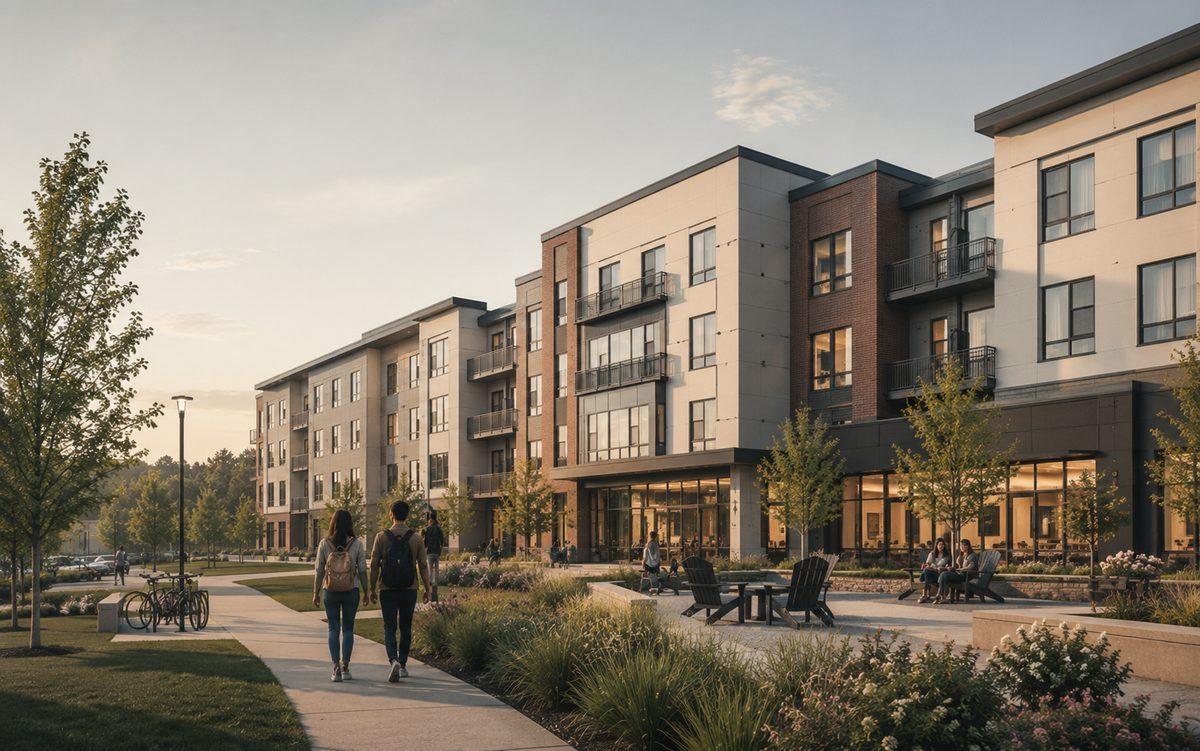
Student housing refers to purpose-built residential communities — apartments and pod-style units — designed for university students, usually located near or adjacent to large campuses. Units are often leased by the bed rather than by the unit, with amenities tailored to students such as study lounges, fitness centers, and shuttle access. In a DST structure, a sponsor acquires stabilized communities serving well-enrolled universities, typically with specialized third-party management, and investors hold beneficial interests in the trust. This gives a 1031 exchange access to a niche residential sector that demands operational expertise to run well.
Purpose-built student housing (PBSH) is distinct from generic apartments that happen to house students. PBSH is designed around the student lifestyle and lease cycle, often clustering bedrooms with private bathrooms around shared common areas, and is usually positioned within walking or shuttle distance of campus. The closer and more purpose-built the asset, generally the stronger its appeal to students — though location and quality relative to competing options always matter.
Demand drivers
Student housing demand is anchored to enrollment at the specific university the property serves:
- ›Enrollment levels and trends at the host institution, especially large public flagship universities.
- ›The university's own housing supply — schools that house only a fraction of students on campus create demand for off-campus beds.
- ›The desirability of the school and its ability to attract students regionally and nationally.
- ›Proximity and quality relative to competing off-campus options.
Because demand is tied to enrollment rather than the local job market, student housing can behave differently from conventional apartments across economic cycles — sometimes seen as counter-cyclical, since enrollment can hold up or even rise in downturns. That is a tendency, not a guarantee; enrollment trends and past performance do not guarantee future results.
Why 1031 and DST investors choose it
Demand at established schools tends to be relatively stable and less tied to local employment than conventional apartments. Per-bed leases are frequently backed by parental guarantees, which can support collections, and annual leasing cycles let rents reset each academic year, offering some inflation responsiveness. For 1031 exchangers, a DST converts an operationally demanding asset into a passive, tax-deferred holding managed by specialists who run the intensive annual leasing and turnover process.
Lease and income structure
Leases generally run about 12 months aligned to the academic calendar, with most leasing concentrated in a single pre-fall window — meaning a strong or weak "lease-up" season heavily shapes the year. Income features include:
- ›By-the-bed leasing, which diversifies income across many individual tenants within each unit.
- ›Parental guarantees, which can improve payment reliability.
- ›Annual rate resets, allowing rents to move with the market each year.
- ›Ancillary revenue such as parking and amenity fees.
Student housing DSTs commonly illustrate target distributions in roughly the 4%–6% annual range, paid from net operating income and not guaranteed. Turnover, marketing, and summer unit-refresh costs can be significant, since most of the community turns over at once.
Typical DST hold and business plan
A student housing DST typically targets a hold of roughly five to ten years. Business plans often focus on stabilized communities near well-enrolled universities, with the operator working each year to maximize the pre-fall lease-up, push rents, control turnover costs, and maintain the property's competitiveness. Some sponsors pursue light value-add upgrades to support rent growth. Given how operationally intensive and timing-sensitive student housing is, the specialized operator is one of the most important factors in the deal.
Illustrative return and distribution ranges
All figures are illustrative, not guaranteed. A student housing DST might illustrate:
- ›Current distributions of roughly 4%–6% annually, paid monthly from net operating income.
- ›Annual rent growth assumptions tied to each leasing season.
- ›A potential gain on sale depending on the market and the school's strength at exit.
Actual results can be lower, distributions can be reduced or suspended, and the exit value is unknown. Past performance does not guarantee future results.
Key risks
- ›University concentration — performance is tied to one school's enrollment and housing policies.
- ›Lease-up timing risk — most leasing happens in one window; a missed season is hard to recover within the year.
- ›New supply, including new on-campus dorms or nearby off-campus construction, can pressure occupancy and rents.
- ›Operational intensity — annual turnover, marketing, and management demand specialized expertise.
- ›Leverage magnifies gains and losses.
- ›Illiquidity and loss of control — no secondary market, decisions rest with the sponsor.
Distributions can be reduced or suspended, and principal is at risk.
Market and operator considerations
Evaluate the specific university: enrollment size and trend, selectivity, the share of students housed on campus, and the pipeline of competing supply nearby. Then evaluate the asset's position — distance to campus, age and amenities relative to competitors, and historical occupancy and lease-up performance. Finally, scrutinize the operator, since specialized student-housing managers run the marketing, leasing, and turnover that determine results. Review the PPM and the underlying enrollment data carefully.
Tax and depreciation angle
As residential real estate, student housing held through a DST is depreciated over 27.5 years, and that depreciation passes through to investors, potentially sheltering part of the distributions so a portion may be tax-deferred rather than fully taxable. At the end of the hold, a 1031 exchange into another property or DST can continue deferral, and a 721 UPREIT roll-up may be available. Tax outcomes depend on your situation — consult your CPA and attorney.
How to access student housing through a DST
Student housing DSTs are private securities offerings for accredited investors, accessed through a sponsor or broker-dealer. As 1031 replacement property, identify the DST within 45 days of selling and close within 180 days, using a qualified intermediary to hold proceeds. The sponsor and specialized manager handle leasing and operations and may eventually sell or offer a 721 roll-up. Because results depend heavily on the specific school and operator, read the documents closely and consult your CPA and attorney before investing.
Who it suits
A student housing DST may suit 1031 investors who want demand tied to university enrollment rather than the local job market, who value per-bed leasing with parental guarantees, and who can accept single-school concentration, lease-up timing, and illiquidity risks. It is less suited to those needing liquidity, wanting guaranteed income, or who are not accredited. This material is educational and not investment, tax, or legal advice.
See your matched options
Get illustrative DST, net-lease, and fund options for your exact situation — free, with no obligation.
Key takeaways
- ✓Student housing demand is anchored to university enrollment, which tends to be steadier than local job-driven apartment demand.
- ✓Per-bed leasing with parental guarantees can support occupancy and collections, but income still depends on the lease-up season.
- ✓Concentration in one university and the annual lease-up window create real timing and enrollment risk.
- ✓Student housing DSTs are illiquid accredited-investor securities; illustrative distributions often fall in the 4%–6% range.
Frequently asked questions
Why do investors like student housing for a 1031 exchange?+
Demand is tied to university enrollment, which is relatively stable at established schools, and per-bed leases often carry parental guarantees. A DST makes this operationally intensive asset passive and tax-deferred.
What is lease-up risk?+
Most student leasing happens in one window before the fall term. If a property fails to lease up well that season, the shortfall is hard to recover during the year, which makes timing and management critical.
What is the biggest single risk?+
Concentration in one university. Falling enrollment, new on-campus dorms, or nearby new construction can pressure occupancy and rents at a specific property.
How are student housing leases structured?+
They typically run about 12 months aligned to the academic year and are often leased by the bed rather than by the unit, frequently with a parental guarantee backing each lease.
Related reading
This article is educational and not tax, legal, or investment advice. 1031 exchanges are complex — consult your own CPA and attorney. DST and fund offerings are securities available to accredited investors only; all examples are illustrative.