
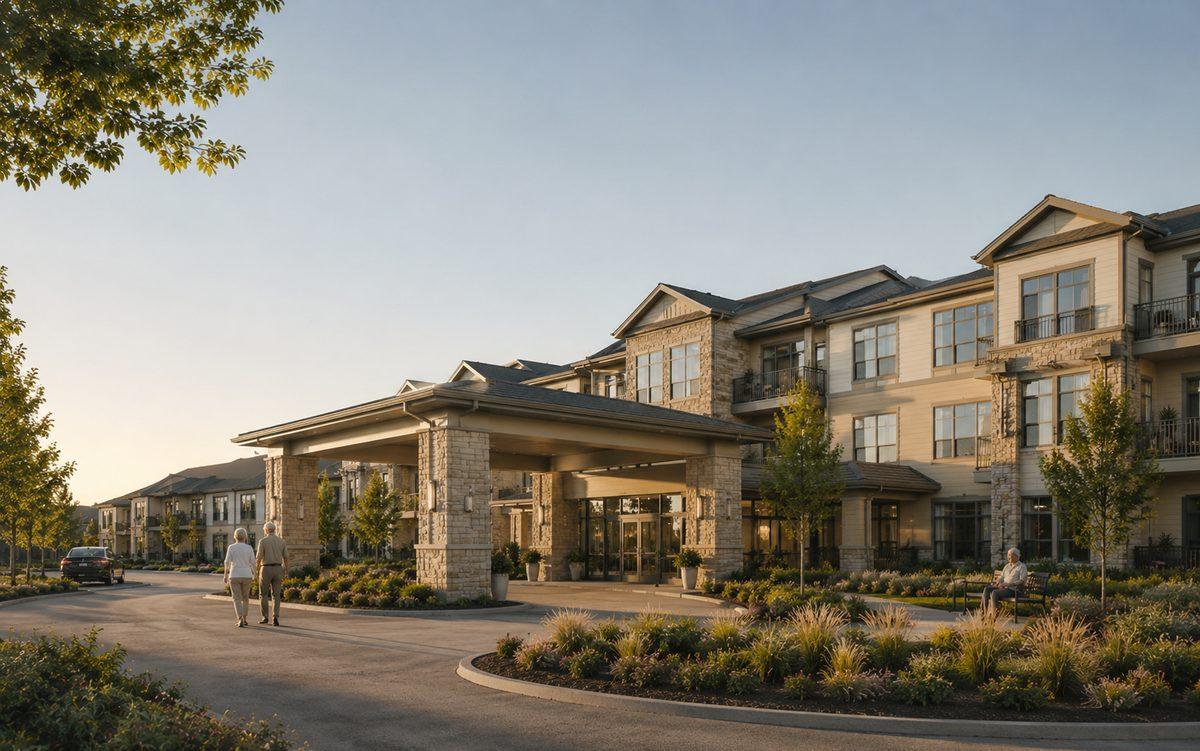
What senior housing is
Senior housing spans a continuum of care, and understanding where a property sits on that continuum is essential:
- ›Independent living (IL) — largely residential apartments for active seniors, with amenities, dining, and social programming but minimal care.
- ›Assisted living (AL) — residential living plus help with activities of daily living such as bathing, dressing, and medication management.
- ›Memory care — specialized, secured environments for residents with dementia or Alzheimer's, with the highest staffing and care intensity.
Many communities combine multiple levels under one roof. These properties blend real estate with hospitality and care services, so operating results depend on both occupancy and the operator's execution. In a DST structure, a sponsor partners with experienced operators to run stabilized communities, and investors hold beneficial interests in the trust. This gives a 1031 exchange exposure to a needs-based, demographically supported sector that individuals rarely access directly.
Demand drivers
The senior-housing thesis is fundamentally demographic and needs-based:
- ›An aging population, including the large baby-boomer cohort moving into the prime ages for senior living.
- ›Longer life expectancy, increasing the years many people spend needing some level of support.
- ›Need-driven rather than discretionary demand, especially for assisted living and memory care, which can make it relatively resilient across economic cycles.
- ›Family and caregiving dynamics that lead households to seek professional care settings.
These tailwinds support long-run demand, but they do not guarantee performance at any community. Local supply, pricing, and especially operator quality drive results. Demographic tailwinds and past performance do not guarantee future results.
Why 1031 and DST investors choose it
Because much of the demand — particularly for higher-acuity care — is needs-based rather than discretionary, occupancy can be relatively durable even in downturns. The sector also offers exposure to a healthcare-adjacent, demographically supported theme that is hard to access directly. For 1031 exchangers, a DST turns an operationally complex, service-heavy asset into a passive, tax-deferred holding run by specialists, while preserving capital-gains deferral.
Lease and income structure
Senior housing income often resembles an operating business as much as a lease. Residents typically pay monthly fees for housing plus services and care, and revenue moves with occupancy, the mix of care levels (higher-acuity care commands higher fees), and rate increases. Common structures include:
- ›Owner-operated / RIDEA-style arrangements, where the property's results reflect the operating performance of the community.
- ›Master leases, where an operator leases the community and pays rent, shifting more operating risk to the operator.
Senior housing DSTs commonly illustrate target distributions in roughly the 4%–6% annual range, paid from net operating income and not guaranteed. Labor and staffing are major expense drivers — wage pressure and staffing availability can materially affect distributions.
Typical DST hold and business plan
A senior housing DST typically targets a hold of roughly five to ten years. Business plans vary with the structure: a master-leased deal emphasizes stable contractual rent from the operator, while an owner-operated deal seeks to grow net operating income by improving occupancy, optimizing care-level mix, and raising rates. In either case, the operator partnership is central. Sponsors generally pair with experienced senior-living operators because day-to-day execution of care, staffing, and occupancy determines outcomes far more than in passive, lease-based property types.
Illustrative return and distribution ranges
All figures are illustrative, not guaranteed. A senior housing DST might illustrate:
- ›Current distributions of roughly 4%–6% annually, paid monthly from net operating income.
- ›Occupancy and rate growth assumptions, especially for owner-operated deals.
- ›A potential gain on sale depending on operating performance and the market at exit.
Operating-intensive assets can show more variability than simple net-leased property, and distributions can be reduced or suspended. The exit value is unknown. Past performance does not guarantee future results.
Key risks
- ›Operator dependence — results hinge on how well the operator manages care, staffing, and occupancy.
- ›Labor availability and wage pressure — staffing is a major, sometimes volatile, expense.
- ›Regulatory and licensing requirements add complexity and compliance risk.
- ›Local competition and new supply can pressure occupancy and rates.
- ›Health-related events can disrupt occupancy and elevate costs.
- ›Leverage magnifies gains and losses.
- ›Illiquidity and loss of control — no secondary market, decisions rest with the sponsor and operator.
Distributions can be reduced or suspended, and principal is at risk.
Market and operator considerations
Because senior housing is an operating business, the operator's track record is arguably the single most important factor — their experience, occupancy history, staffing model, and care quality. Also assess the local market: the supply of competing communities, demographic depth of the senior population, and pricing. Consider the care-level mix (higher-acuity care is more management-intensive but higher-fee) and the deal structure (master lease versus owner-operated). Review the PPM, operator history, and market supply carefully.
Tax and depreciation angle
Senior housing held through a DST generates depreciation that passes through to investors, which can shelter part of the distributions so a portion may be tax-deferred rather than fully taxable; some structures and service revenue can complicate the tax picture. At the end of the hold, a 1031 exchange into another property or DST can continue deferral, and a 721 UPREIT roll-up may be an option. Because senior housing tax treatment can be nuanced, consult your CPA and attorney about your specific situation.
How to access senior housing through a DST
Senior housing DSTs are private securities offerings for accredited investors, accessed through a sponsor or broker-dealer. As 1031 replacement property, identify the DST within 45 days of your sale and close within 180 days, using a qualified intermediary to hold proceeds. The sponsor and operator handle care and management and may eventually sell or offer a 721 roll-up. Because results hinge on the operator and local market, read the documents closely and consult your CPA and attorney before investing.
Who it suits
A senior housing DST may suit 1031 investors who want exposure to demographically driven, needs-based demand and who understand they are buying into an operating business that depends heavily on the operator, and who can accept operational, regulatory, and illiquidity risks. It is less suited to those seeking simple, low-variability lease income, needing liquidity, wanting guaranteed returns, or who are not accredited. This material is educational and not investment, tax, or legal advice.
See your matched options
Get illustrative DST, net-lease, and fund options for your exact situation — free, with no obligation.
Key takeaways
- ✓Senior housing is demographically driven and largely needs-based, which can make demand relatively resilient.
- ✓Income often behaves like an operating business — monthly fees for housing plus services — not a simple lease.
- ✓Operator quality, staffing and wage pressure, and regulation are pivotal and operationally intensive risks.
- ✓Senior housing DSTs are illiquid accredited-investor securities; illustrative distributions often fall in the 4%–6% range.
Frequently asked questions
What types of properties fall under senior housing?+
Independent living, assisted living, and memory care — a continuum from largely residential to specialized care. Many communities combine multiple care levels under one roof.
Why is operator quality so important?+
Senior housing blends real estate with hospitality and care services, so results depend heavily on how well the operator manages staffing, care, and occupancy — more than in passive lease-based property types.
What are the main risks?+
Operationally intensive management, staffing and wage pressure, regulatory and licensing requirements, local new supply, and health-related disruptions to occupancy. Distributions can be reduced or suspended.
Who can invest in a senior housing DST?+
These are private securities offerings available to accredited investors through a sponsor or broker-dealer, not on public exchanges.
Related reading
This article is educational and not tax, legal, or investment advice. 1031 exchanges are complex — consult your own CPA and attorney. DST and fund offerings are securities available to accredited investors only; all examples are illustrative.